


AI is moving out of the experimentation phase and into production. That shift is putting pressure on something companies don’t always plan for: the infrastructure behind these systems.
A 2026 Google Cloud study found that 83% of organizations need to upgrade their infrastructure to support production-grade agentic AI. Getting there takes more than one team. It means bringing cloud, backend, data, security, DevOps, and AI engineering together to build systems that are reliable and secure.
In this article, we’ll look at the engineering skills companies need to build AI-ready infrastructure, the role of security and DevSecOps, and why the right mix of technical expertise matters for getting AI systems into production.
The Intersection of AI, Infrastructure, and Security
AI is no longer something companies can just bolt onto an existing tech stack. As organizations lean on AI for customer experiences, automation, analytics, and core business operations, these systems depend on a much wider engineering foundation than most people expect.
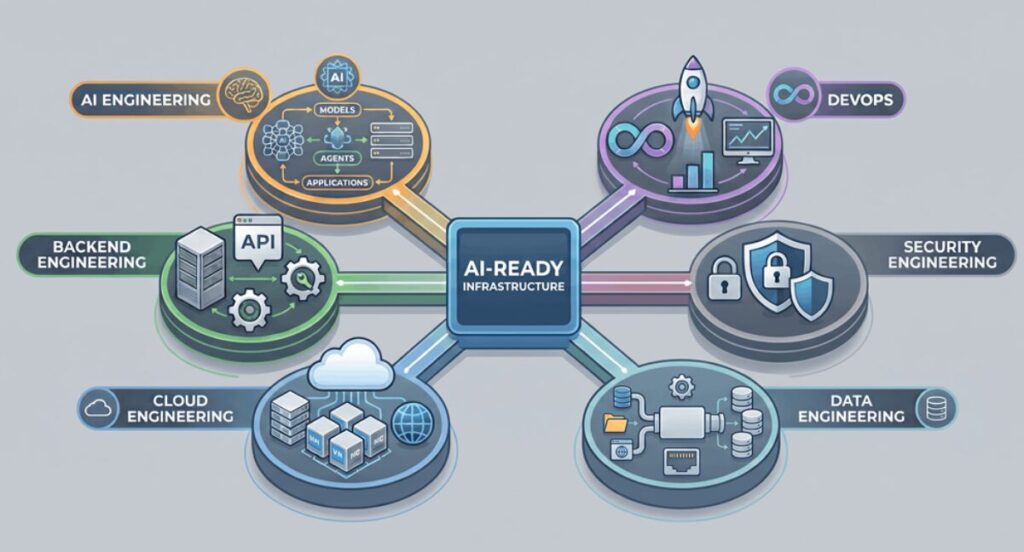
Building AI-ready infrastructure takes several areas of expertise working together:
- AI engineering connects models, agents, and AI applications to the systems they need to perform useful tasks.
- Backend engineering provides the APIs, services, and application logic that link AI capabilities to business systems.
- Cloud engineering creates the scalable infrastructure needed to deploy and run AI applications reliably.
- Data engineering makes sure AI systems have access to reliable data through well-designed pipelines, storage, and integration.
- Security engineering protects models, data, applications, and users from threats across the AI environment.
- DevOps supports automation, deployment, monitoring, and the operational reliability of these systems.
Hiring more AI developers alone will not solve the problem. A production AI system has to work inside a larger technical environment, one where data is reliable, infrastructure scales, and applications stay secure and observable.
As AI adoption spreads across industries, companies also need qualified developers, data scientists, AI specialists, and other technical professionals to turn these systems into practical business solutions.
The engineering landscape is becoming more interconnected, and AI expertise is most valuable when it’s paired with strong infrastructure and security fundamentals.
The Engineering Skills Behind AI-Ready Infrastructure
Building an AI system is only the first step. To run reliably in production, it has to connect with APIs, data pipelines, cloud infrastructure, security controls, and monitoring systems. That’s why AI engineering now overlaps with traditional software and infrastructure work.
An AI infrastructure engineer needs to understand how these layers fit together. The job goes beyond integrating a model or building an AI application. It also means making sure that system can be deployed, monitored, secured, and maintained over time.
A few capabilities matter most here:
| Skill Area | What It Involves |
| AI engineering and model integration | Connecting models and AI services to applications and business workflows. |
| Backend and API architecture | Building the services and APIs that let AI systems interact with other applications and data. |
| Cloud infrastructure | Creating scalable environments for deploying and operating AI workloads. |
| Data architecture | Building reliable pipelines and data systems that AI applications can depend on. |
| Automation and observability | Automating infrastructure and monitoring system performance, usage, and failures. |
| Security engineering | Protecting models, data, APIs, and applications throughout the development lifecycle. |
| Testing and deployment | Validating AI systems and moving them into production while maintaining reliability and performance. |
Running these systems in production takes all the above working together, not any one skill in isolation.
This growing skill set reflects a broader shift in AI development. AI engineers sit between data science and software engineering, turning models and AI capabilities into production systems that can be integrated and scaled.
Tools like Google AI Studio show how this integration is playing out. Devs can experiment with models, test prompts, generate code, and prototype AI-powered features before wiring them into real applications.
You may also like: Top Engineering Roles in 2026: What Employers Want
Building Security Into AI Infrastructure
As AI systems get more connected to business data, APIs, and external tools, security can’t be a final step before launch anymore. AI applications need security built into the infrastructure from day one, especially when the system can make decisions and take actions with limited human oversight.
This is where DevSecOps architecture matters.
Instead of separating development, operations, and security into different phases, DevSecOps folds security practices into the entire software lifecycle. For AI systems, that means securing data pipelines, APIs, models, deployment environments, and access controls while testing and monitoring continuously.
AI agents raise the stakes further.
An agent might need to access a database, call an API, retrieve sensitive information, or take action in another business system. The more it can do, the more it matters to define exactly what it’s allowed to access.
That’s driving demand for an agentic AI permission control framework. Organizations are looking for structured ways to manage agent identities, permissions, tool access, and authorization. Cloudflare’s approach to agent security, for example, focuses on identity, scoped permissions, and governance for AI agents and the tools they touch.
Cloudflare’s recent security guidance points to a core tension: AI systems make decisions probabilistically, but security policies need to be deterministic. Agents need explicit boundaries, enforceable permissions, and controls that operate at machine speed.
As AI applications reach further into the internet and enterprise systems, the infrastructure around them will need to account for both human and nonhuman identities.

Security in the Age of Agentic AI
Companies looking to build secure and scalable AI systems need engineers who understand how AI works alongside:
- Cloud infrastructure
- Backend systems
- Data pipelines
- Security controls
- DevOps practices
That combination of skills is hard to find, especially with demand for AI engineering talent still climbing.
Techunting connects companies with experienced technology professionals who support the development of AI-ready infrastructure, from AI engineering and backend development to cloud, DevOps, data, and security.
Whether your company needs to grow an existing team or build a new AI capability from scratch, having the right engineering talent is what separates an experiment from a production-ready system.
AI Success Starts With the Right Foundation
AI-ready infrastructure depends on talent behind it. Companies that invest in the right engineering foundation now will be better positioned to move from experimentation to reliable production as AI becomes a bigger part of everyday business systems.
Looking to build your AI team? Hire an AI-ready team of engineers with Techunting.
Frequently Asked Questions About AI-Ready Infrastructure
Here are a few common questions about AI-ready infrastructure and what it takes to build it.
What is AI-ready infrastructure?
AI-ready infrastructure is the combination of cloud, backend, data, security, DevOps, and AI systems needed to build, deploy, and scale AI applications reliably.
What does an AI infrastructure engineer do?
An AI infrastructure engineer connects AI capabilities with the systems that support them, including APIs, cloud infrastructure, data pipelines, security controls, deployment, and monitoring.
Why is security important for AI infrastructure?
AI systems can access sensitive data, APIs, tools, and business systems. Strong security practices, including DevSecOps architecture and structured permission controls, help reduce risk while keeping AI applications reliable and scalable.