


When companies begin their journey to scale engineering teams, the natural first step is often traditional recruiting services. That makes sense: you define roles, you hire people, and you build your internal team. However, as business needs become more dynamic and global, many organizations find that the staff-augmentation model offers more flexibility, speed, and scalability.
At Techunting we’ve seen this transition many times: clients initially engage a recruiting model, and then shift to staff augmentation once they’ve experienced the benefits firsthand. In this article, we will explore the reasons for this switch, its advantages and disadvantages, and the right move for each business.
From a Few Hires to a Full Team
Many clients come to us thinking they need recruiting: they want to fill two or three important roles and build up their in-house team. But what they discover during the initial phase is that:
- The engineers we bring in integrate smoothly, work to high standards, and deliver quickly. They’re often recognized by clients as key contributors and top performers within their teams, true “rockstars”.
- The overhead of managing global hiring, compliance, payroll, and taxes begins to look far greater than the cost of purely hiring talent.
- Once they’ve seen how effective the remote talent is, they start asking: “Why don’t we scale this into a full team?”
A clear example is our partnership with HTD Health, a strategy and technology consultancy dedicated to healthcare transformation. Our contract with the company began under a recruiting contract covering a handful of roles. After seeing how high-calibre the engineers were, HTD Health elected to expand into a full augmented team model through staff augmentation. This allowed them to move from recruiting a few individuals to building a dedicated team aligned with their product roadmap.
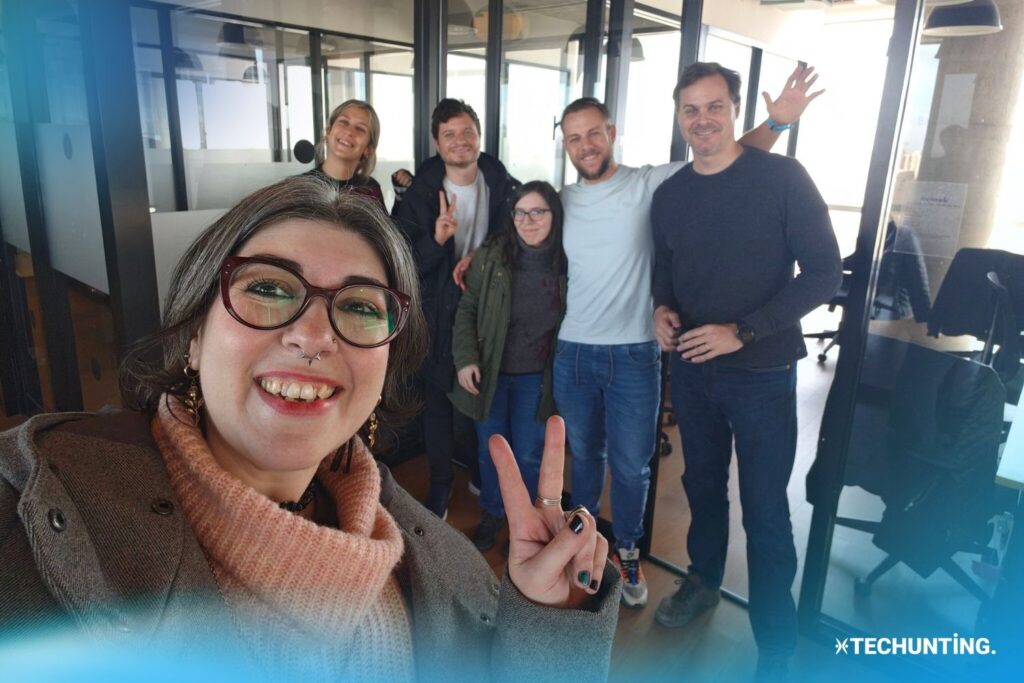
HTD Health team gathering in Buenos Aires with visits from the company’s headquarters in Polonia
The pattern is common: start with two or three roles to test the collaboration, then expand to a full outsourced team in Latin America with Techunting. The switch often occurs once the client recognises that managing local operations, especially internationally, is burdensome.
Why the Switch Makes Business Sense
Hiring talent in Latin America is surprisingly straightforward. The real challenge is managing that talent. That includes local employment laws, public holidays, payments, taxes, benefits, and termination policies. For many companies, especially those based outside Latin America, these fall outside their core competency.
By shifting to a staff-augmentation partner, companies offload the administrative, legal, and compliance burdens. They can focus solely on business priorities: product development, user acquisition, and scaling engineering capacity. Meanwhile, the partner handles contracts, payroll, compliance, and local infrastructure.
There’s also a market-driven advantage. According to research by the international consultancy IDC, the Latin America and Caribbean region will need an additional 2.5 million ICT-related professionals by 2026, on top of the existing pool of about 6.3 million. This talent shortage underscores why companies that secure access to high-performing engineers in LATAM and partner with a management advisor like Techunting gain an edge. The shortage means competition for talent is increasing, and the infrastructure around staffing, benefits, compliance, and global coordination becomes a key differentiator.
Plus, the staff-augmentation model allows for rapid scaling. When a client sees successful collaboration with an initial few roles, they can roll out an extended team across multiple functions—software engineering, QA, DevOps, UX/UI—in a matter of weeks rather than months. That agility is hard to match in traditional recruiting.
When Recruiting Still Makes Sense
It might seem like staff augmentation always wins, but that’s not the case. Traditional recruiting remains a solid choice under certain conditions:
- When a company already has a legal presence in a country (an entity, payroll, HR team) and wants to expand its in-house team locally.
- When hybrid or in-person collaboration is important for security clearance or cultural reasons.
- When the roles are highly strategic and the company intends to embed talent deeply into its culture and long-term organization structure.
In those situations, recruiting is a great model. For example, Techunting can assist by sourcing local professionals in the country of expansion, helping with assessment, onboarding, and ensuring cultural fit. The difference is that in this case, the company is comfortable managing local employment logistics by themselves.

The Hybrid Model: Best of Both Worlds
Many of our clients combine both models: they hire local talent in their home countries for roles that need to be on-site or hybrid, and concurrently build remote teams in Latin America through staff augmentation. This blended strategy offers the best of both worlds:
- Local presence and face-to-face interaction when it matters.
- Global reach, cost-efficiency, scalability, and time-zone-friendly collaboration through remote teams.
- Flexibility to scale teams up or down depending on project needs, without the overhead of opening additional legal entities.
For example, a company recently approached us looking to hire a product manager and UX designers in its headquarters in Canada, but staff the bulk of engineering (frontend, backend, QA) in Latin America, managed through the staff augmentation model. This ensures the core leadership and creative initiatives remain co-located, while the extended team operates remotely but is tightly integrated.
Why Latin America Is Such a Strategic Region
Beyond the operational advantages, Latin America offers distinct strategic benefits for companies building engineering teams:
- Quality of talent: The region has a growing number of engineers versed in modern tech stacks, many bilingual, and comfortable working with global clients.
- Time-zone alignment: LATAM time zones often overlap with North America, making coordination simpler than other offshore regions.
- Cost-effectiveness: While standards are high, the cost base is often lower than in many US or Western European markets, offering better value for companies.
- Talent pool urgency: As previously noted, the region is facing a projected shortfall of 2.5 million ICT professionals by 2026. Companies that position themselves early and partner appropriately can access top talent before competition intensifies.
According to a report by World Economic Forum on Latin America & the Caribbean, “the demand for skilled talent is leading to calls for more public funding for reskilling and upskilling”. Additionally, “Across the region, 80% of companies expect talent development to improve among their workers in the next five years, while barely over a third see talent availability improving on the open market.”
These factors make LATAM a compelling region for companies looking to scale engineering rapidly, competitively, and with fewer of the typical pains of global hiring.
Explore the top 5 tech hubs in Latin America.
Ready to Build Your Team in LATAM?
In today’s fast-moving tech landscape, companies can no longer afford to be limited by slow hiring ramp-up, heavy administrative overhead, or regional compliance complexity. While recruiting services will always have their place, particularly for local in-house growth, the staff-augmentation model provides a powerful alternative for global, scalable, flexible team building.
At Techunting, we’ve seen the journey many clients take: they start with recruiting, see strong results from remote engineers, recognise the operational burden of managing international hires, and switch to staff augmentation. The case with HTD Health is just one illustration of how this works in practice.
Ultimately, whether you build your team via recruiting, augmentation, or a hybrid of both depends on your business model, time-zone needs, local presence, and long-term goals. If you’re focused on speed, scalability, and global talent access, especially in Latin America, the staff-augmentation model offers compelling advantages.
If you’re exploring ways to scale your engineering team or want to understand which model is best for your business, our experts can help. Contact us to schedule a free consultation and discover how we can help you hire, expand, and manage world-class tech talent.